
On Feb. 6, the Iowa House passed HF2338, a bill prohibiting any mention of sexual orientation or gender theory in K-12 schools. The justification for this bill has been that it is necessary to prevent the “corruption of the youth.” This is a statement echoed in our current political climate, with many bills and legislation at the state as well as federal level passing under this guise of protecting the youth from corruption. The range of these legislations is vast, covering aspects from ID-mandated verification on social media platforms to censorship of artistic and educational material in schools, as well as other public spheres. These bills disproportionately target people within the LGBTQ+ sphere.
The presumption that anything to do with sexuality or gender is entirely taboo is hypocritical as well as unfair. Strictly speaking, the narrative that heterosexual relationships are the truest form of love, historically contextualized by religious ideals, is also an opinion, similar to any other interpretation of gender or sex. The difference lies strictly in the reasoning one relies on, and not on whether this reasoning itself is sound and rational.
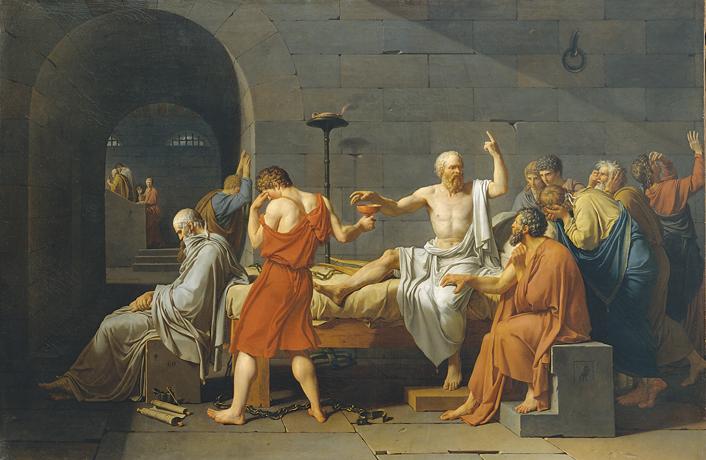
The notions of sexuality and gender and their expansive variety are not modern inventions. The ancient Greeks, who are often praised for their philosophical magnificence, in fact praised homosexual relationships as the superior form of love. This is a topic discussed in detail in Plato’s “The Symposium,” a book recently banned at Texas A&M. Socrates, who is the main character and arguably the origin of the ideas discussed in texts by Plato, is often hailed as the father of Western philosophy. Yet he was sentenced to death for the same charge of “corrupting the youth.”
This historical parallel is purposeful. The entirety of Socrates’ trial was spent in his defence of how he had not, in fact, corrupted the youth, yet this was all in vain. In retrospect, academics as well as critics of Socrates’ philosophy understand that the context of his death was not what was stated but was rather to remove him as an obstacle. Socrates presented a threat to the new Athenian government that sought to be more aristocratic and authoritarian. This threat was not a threat of mutiny or a “domestic terrorism” plot. This threat was the one thing everyone prizes but few understand: Critical reasoning.
Socrates may not have categorized his actions as critical reasoning. For him, the pursuit of knowledge was not just to know, but to specifically know the truth. He implored his students and all those around him to inquire and investigate even the most fundamental premises. This offended the religious authorities — who labeled him a blasphemer for questioning and hence insulting the gods — as well as the corrupted governance of Athens, who believed his persistence in seeking truth as well as high wisdom would shatter the myths on which they created their state.
Socrates was killed because he questioned the status quo, and with him came the death of reason. Socrates was not just a reasonable man. He was the embodiment of reason. The charge of corrupting the youth was only the channel through which reason and criticality were executed.
We are again in the same epoch. The charge of “corrupting the youth” is only an in through which marginalization of one community begins, followed by censorship of everything associated with the group and eventually the curtailment of all freedoms and rights. I believe it is too obvious to draw the parallel between the death of reason with the resultant dystopias seen in “1984” or “Fahrenheit 451.”
Politicians who leverage morality to argue that surveillance and anti-trans or anti-LGBTQ legislation is needed do not have your best interests in mind. Protecting children asks for more than the banning of books or the mere eradication of identity that many people align with. It is an avenue through which they curtail not just the freedoms of a marginalized minority, but rather everyone’s. It will not be long before the Athenian-inspired democracy we prize will not be such anymore unless we present a united front against the modern death of Socrates.


