
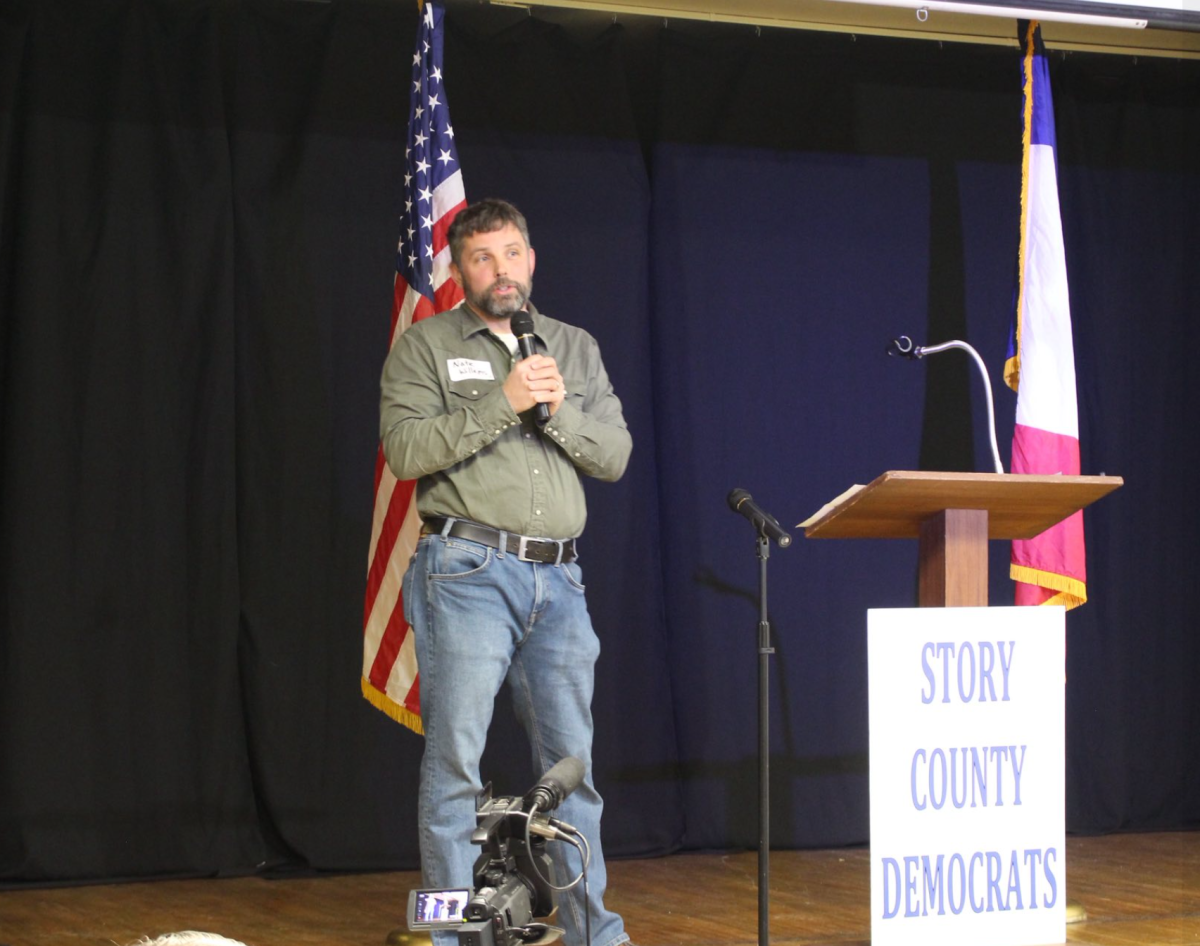
The Story County Democrats hosted their annual “Soup and More” fundraiser at the Collegiate United Methodist Church on Saturday.
More than 300 people attended the fundraiser that featured eight Democratic speakers who are running for various Iowa offices. Donations collected at the event went to local food banks and the Story County Democratic Party.
Maddie Anderson, the county chair of the Story County Democrats, said the event totaled its highest attendance number since 2020.
“I counted at least 320 people, which is more people than we’ve had since Kamala Harris was here running for the nomination in 2020,” Anderson said.
Nate Willems, a candidate for attorney general, said he attended the Soup and More event 23 years ago.
“I actually came to this event 23 years ago when I was a staffer,” Willems said. “Story County is home to a lot of activism. This is a part of Iowa where people pay a great deal of attention and certainly want to be engaged and hear from candidates.”
Willems added that the people he spoke with are ready for a change in Iowa’s statewide offices.
“The biggest concern people articulate is that they’re just hungry to win,” Willems said. “The people are looking forward to this election and having the opportunity to retake our state this November.”
After working for 18 years as a lawyer, Willems said he is running for the attorney general’s office to rebuild Iowa’s Consumer Protection Division, an agency that protects the public from “fraud, deception and unfair business practices.”
“I’m running for attorney general to rebuild the Consumer Protection Division that Tom Miller built over the course of 40 years,” Willems said. “I want the attorney general’s office to take a role in prosecuting corporate crimes, particularly crimes against workers, where wages are stolen from people’s paychecks.”
Teri Veysey, a fundraiser attendee, said she and many others shared concerns regarding voting rights after the SAVE America Act passed the U.S. House of Representatives on Feb. 11. The bill would require voters to provide additional proof of their citizenship when registering to vote and show an ID to cast a ballot.
Critics of the bill argue that the SAVE America Act would wrongfully disenfranchise millions of voters. Specifically, voting rights advocates say that the bill would impact married women because it requires additional documentation to be provided by people whose names do not match their birth certificates.
“We’re really concerned about losing our democracy,” Veysey said. “It’s good to know that there are people that feel the same way and want change to happen.”
Veysey added that engaging with the community and donating to the fundraiser are the best ways to advocate for specific issues.
Despite concerns over federal legislation, the discussion at the fundraiser was largely focused on statewide concerns, including the cost of Iowa’s Education Savings Account (ESA) program and water quality.
Judy Lemish, another event attendee, said her biggest concern is the lack of transparency and the distribution of funds in the ESA program.
Lemish criticized the program for funding private and religious schools, saying the issue goes against the separation of church and state.
Lemish said she was happy to hear candidates discuss the ESA program, believing that the Soup and More event helps spread awareness.
“I think this event gives us a chance to at least feel like we’re doing something,” Lemish said. “We’re raising money and we’re getting people energized to go vote and fight for what they believe.”
Chris Jones, a secretary of agriculture candidate, criticized the state’s handling of water quality issues in his speech.
“I want my candidacy to be a referendum on the quality of Iowa’s water,” Jones said. “We’re not in a water quality crisis, we’re in a state of failure.”
Jones said that the state government has no interest in fixing the water quality because of the influence of corporate interest groups, including Iowa Farm Bureau, Corteva and Cargill.
“The insurance companies and the ungovernable multinational agribusiness corporations always get the outcomes they want,” Jones said. “They always make money, whether or not the farmers make money.”
Jones added that Iowa has paid gas stations $70 million to accommodate ethanol, while the state has spent just $2 million on sourcing local foods to be served in public schools.
“We could supply a free school lunch served with Iowa-grown fruits, vegetables and meat to every student in every Iowa school for less than the cost of the school vouchers,” Jones said.
State Auditor Rob Sand was the final speaker at the Soup and More event. Sand criticized the state for introducing legislation that would give less power to the governor.
“I’ve been saying since May that the insiders in Des Moines are focused on serving themselves and doing what they want to do,” Sand said. “They’re literally advancing bills to limit the power of the next governor. We’re halfway to election day, and they are proving me right.”
In his speech, Sand referred to three bills that have been introduced that would restrict the governor’s power.
If passed, House File 2413 would reduce the term limits of the governor’s board appointees from six years to four years. Lawmakers are considering two other bills that would limit the governor’s power during states of emergencies and increase the Legislature’s influence over budgets and other administrative rules.
“They’re going to pass a bill that says, ‘Hey, I know you put in a guy that says we should fairly fund public schools and says we shouldn’t have a school vouchers program with no accountability in it, but we just don’t care,’” Sand said.
Other speakers at the Soup and More event were Julie Stauch, a candidate for governor; Ryan Peterman, a candidate for secretary of state; Wade Dooley, a candidate for secretary of agriculture; Taylor Wettach, a candidate for state auditor and John Norwood, a candidate for state treasurer.