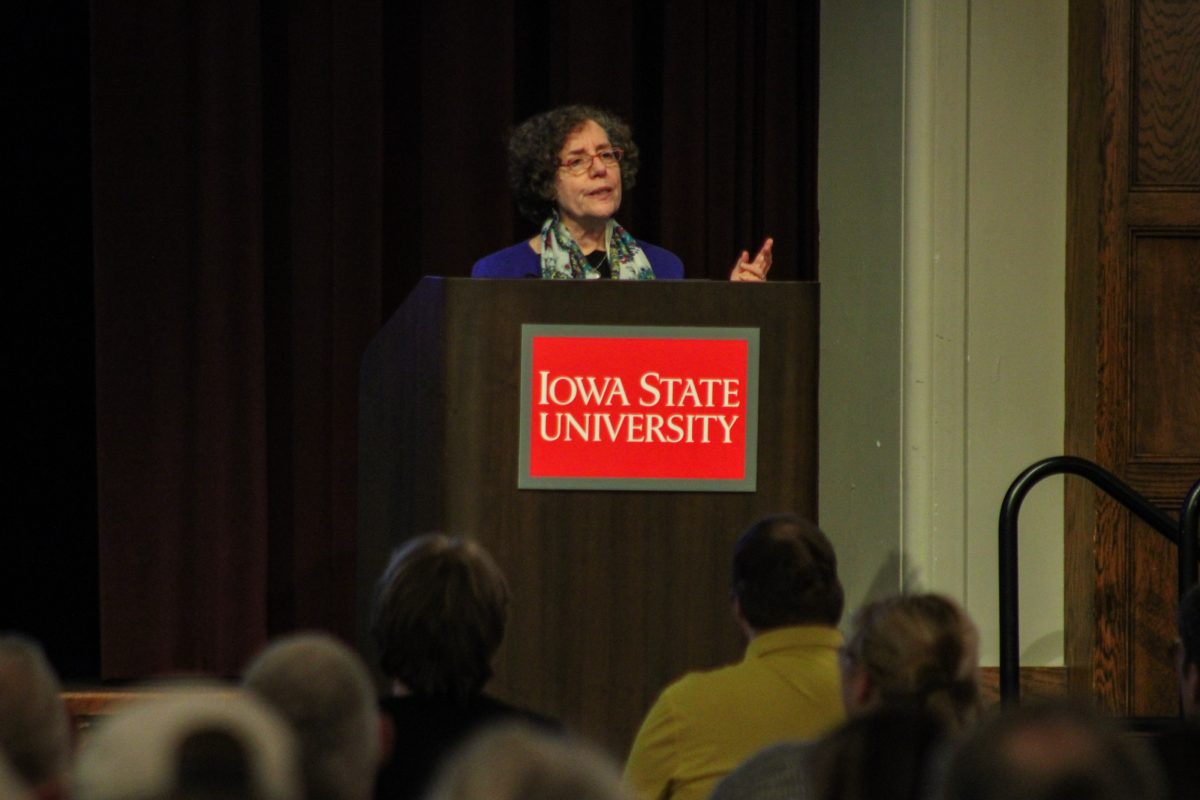
Citizenship schools were created in the 1950s and the 1960s to combat the economic oppression impacting Black women and men in the Deep South. Elaine Weiss, an author and journalist, discussed how these schools developed at 6 p.m. Wednesday in the Memorial Union to a crowd of 105 people.
“[They were] informal classes teaching literacy and civics to those deprived of an education in the Jim Crow South,” Weiss said. “This is the story of citizens standing up in defiance of government oppression to help other citizens stand and reclaim their right to vote.”
“They [Black Americans] were prohibited by the poll taxes, the violent intimidation and especially the literacy tests,” Weiss said.
Black citizens of South Carolina, including Septima Poinsette Clark, Bernice Robinson and Esau Jenkins, all came to the conclusion that they needed a school to teach these adults not only what their rights were, but why it was important for them to fight for their rights. They created the Highlander school.
However, they had to secretly gather to learn because it was dangerous. The Jim Crow South made it illegal for Black people and white people to use the same facilities. The Highlander school had desegregated lunch areas, recreational areas and even sleeping quarters.
“Highlander gleefully defied all of the segregation laws,” Weiss said.
The people in power in this era wanted to keep it that way by economically oppressing Black people and restricting voting rights.
“If you were Black and you tried to register [to vote], and you would be refused, by the time you got back home, the registrar would have called your employer,” Weiss said. “Then you’d be fired. And sometimes your entire family was fired from their jobs. They would call your landlord and your family would be evicted. Would call the bank, and your car loan or mortgage was pulled.”
Communities decided to vote anyway.
“In Tennessee, they decided they were going to vote,” Weiss said. “And then they were all evicted. And they all lost their jobs. Hundreds of people, and they had to live in tent cities in the mud through the winter for two years.”
Yet they continued to have these citizenship schools.
“Septima said literacy is liberation,” Weiss said.
Robinson used to be a schoolteacher, so she volunteered to teach the classes.
“The first thing Robinson had to teach was how to hold a pencil,” Weiss said. “These were people who never held a pencil as a writing instrument. When the students could sign their names, they began to feel different about themselves.”
Even when the school was found out and burned down, it popped back up in another location.
“Highlander is still operating,” Weiss said. “It is coming up on its 95th year. And I think it is really important because the idea of this school and education was you’re not going to be saved by one leader.”
“I think it is important to remember that social movements are made up of thousands of people,” Karen Kedrowski, the director of the Carrie Chapman Catt Center and organizer of the event, said. “And thousands of people who took enormous risks to their life, their health, their livelihood, their children and even their lives. Understanding that there is strength in numbers makes it less scary, but even so, in the civil rights movement, there were thousands of ordinary people who faced incredible pressure to exercise their most basic rights. That is a really important part of our history that we need to learn and honor.”
Stories of people like Robinson, Clark and Jenkins are not often taught in schools.
“I did not recognize most of the names that were brought up,” Diane Patton, Ames resident and Iowa State alumni, said. “It was really wonderful to learn about them and how they met one another and how they supported one another. I was really impressed learning about these schools.”
‘I also think it is important because I don’t think we have done a good job at teaching civics for a generation or two in our schools and I think we are paying the price for that,” Weiss said. “There is a terrible lack of participation in our elections, especially for young people.”
Fiona Winn, a sophomore studying journalism with a minor in political science, agrees.
“I grew up in a small town where government was taught, but most people were cheating through it. So, I don’t think that most people truly understand government, which, if you do not understand something, you aren’t going to participate in it,” Winn said.