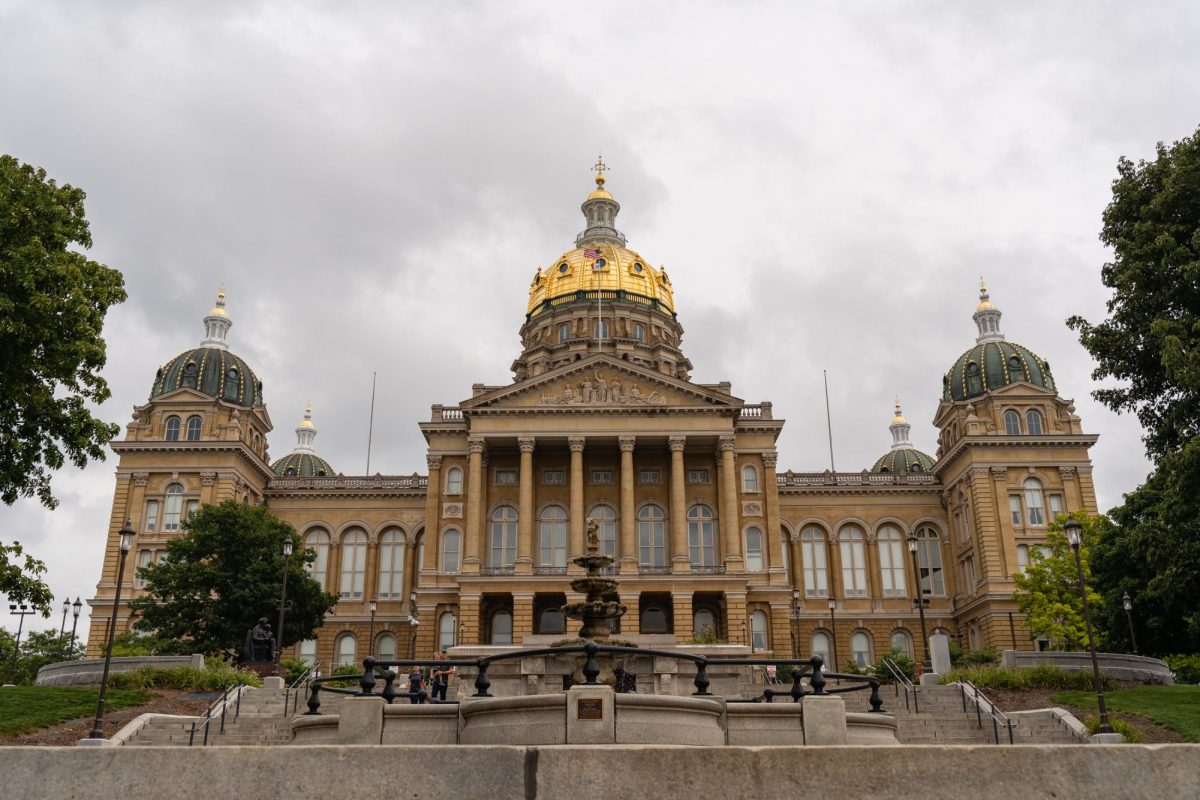
Iowa State University students working as legislative clerks at the Capitol enrich their education and play a valuable role in the day-to-day operations of the legislature. The daily responsibilities of a clerk shift depending on the stage of the legislative session.
“Right now there’s lots of debate at the Capitol on passing bills, but earlier in the session it was a lot of scheduling subcommittees,” Jescey Thompson, a sophomore majoring in agricultural and rural policy studies and clerk for Rep. Carter Nordman (R-District 47), said. “There was one day my legislator had three subcommittee meetings within 45 minutes. I had three different binders in my hands and had to know where we were going every time.”
With the fast-paced legislative process, the clerks must be prepared to adapt to the busy days while leaving a mark of their own. Daily, clerks engage with constituents through email and face-to-face conversations and conduct research for their respective legislator.
“You are really the first point of contact for your representative to research, make suggestions, proposals, to be that link between constituents and what’s being put on the floor,” Quinn Margrett, a senior double majoring in business and economics and clerk for Rep. Elizabeth Wilson (D-District 73), said. “You have an opportunity to have that input.”
From sociology classes to political science classes, Iowa State helped build the skills needed for policy work.
“Taking different sociology classes to fill agricultural and rural policy requirements allowed me to look at issues from different perspectives,” Henry Rose, a junior in agricultural and rural policy studies and clerk for Rep. Taylor Collins (R-District 95), said.
“Iowa State has enriched what I’m doing at the Capitol, and the Capitol has enriched what I’m doing at Iowa State,” Thompson said.
Thompson mentioned an ISU sociology course: Data Discovery & Civic Engagement (SOC 2620).
“Learning about poverty rates and income levels across Iowa has helped me have a deeper understanding of the issues that Iowans face,” Thompson said.
“I think we have a phenomenal political science department,” Margrett says. “I’ve taken all kinds of classes from campaigns and elections to constitutional law and a lot of things in between. I think our political science classes do an exceptional job of preparing people for any role that has to do with government and policy.”