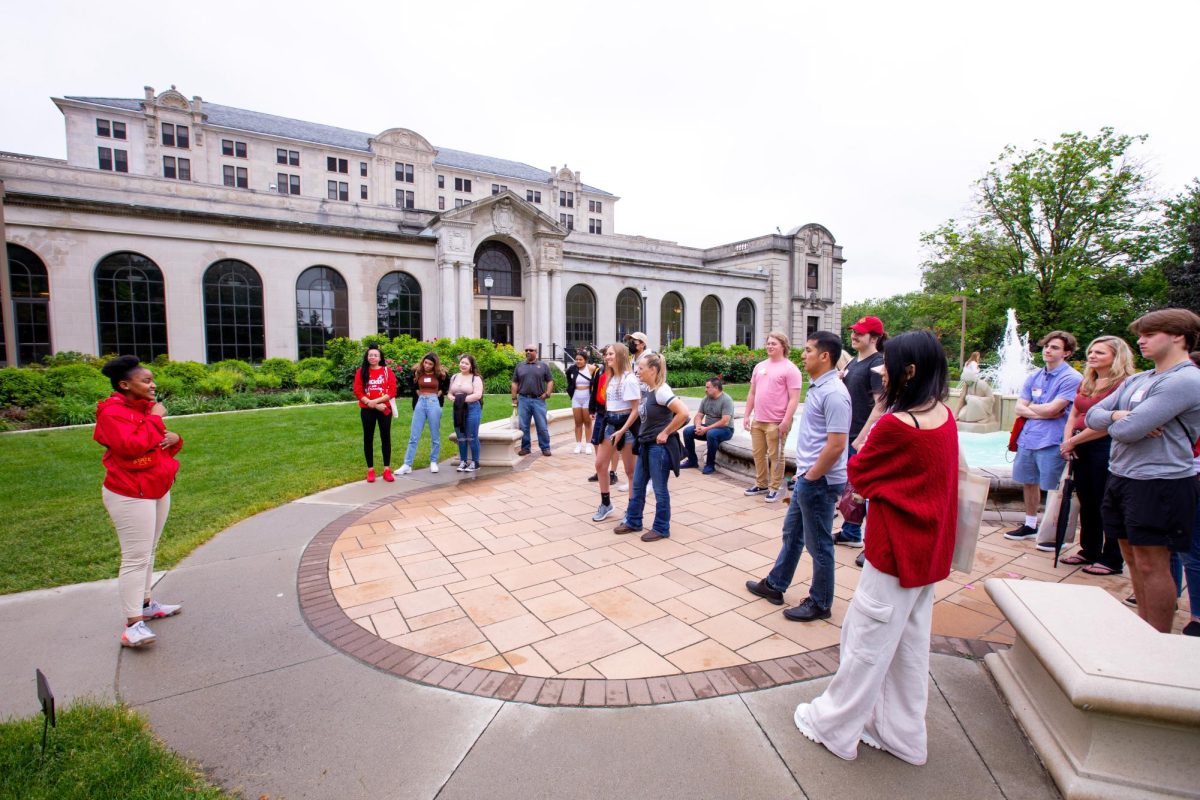

This summer marks the 11th cohort of students to go through the CYstarters program. This cohort is also the largest group thus far, with 16 students participating.
The program is an 11-week accelerator, and participants receive $6,500 to spend on their startup business or venture. The course provides a multitude of resources for students, and during this time, they are expected to be committed and focused on their venture.
Megan Sweere, director of CYstarters and student ventures, spoke in greater detail about the program and what it is trying to give students beyond the funds.
“We help students launch or scale their businesses over the 11-week program that runs over the summer months,” Sweere said. “One of the ways that we talk about it is like interning in your own company, so going for a traditional internship and dedicating your summer to growing a business.”
Sweere spoke about the structure of the program and what is taught to the students when they are not working on their businesses.
“The program is structured around workshop-style education sessions that cover a variety of topics,” Sweere said. “Everything from 101-level things like customer discovery, all the way through more advanced topics. Trying to give entrepreneurs a full toolkit.”
Sweere talked about the eligibility requirements of the program and how competitive it has become in recent years.
“The program is for all current Iowa state students, and within 6 months of graduating,” Sweere said. “We recruit from every college at every level. There is no prerequisite for what stage of business a student has to be in to apply, but we do ask quite a few questions in the application about the business or business idea.”
Sweere went on to describe how the program has changed.
“I would say year over year, the program gets more competitive,” Sweere said. “So making tangible progress on your business before the summer is going to make your application more competitive in the pool.”
Sweere also spoke on how the program accommodates the diverse array of businesses each year.
“The way we accommodate that diverse set of businesses is by, one, the accountability we offer,” Sweere said. “Each student will figure out what their goals are for the summer to accomplish within their business, and then our team holds them accountable to that and gives them the resources they need.

Sweere went into detail about another way they assist the students, through individual mentorship.
“We set them up with a peer mentor, and those are students who are alumni of CYstarters,” Sweere said. “75% of the people who went through the program are still working on their business, either the same or a new one. We also match them with a more professional mentor. It could be a professional from the local community who has a lot of experience in the specific space in which the student needs help. Or it could be a student from an earlier cohort who has really expanded their business.”
This year’s cohort’s students are once again bringing a diverse group of ventures to the program, all at different stages of their development and all with different perspectives.
Jacob Barglof, a junior in computer engineering, is developing a software company. He applied for CYstarters hoping to grow as a professional and develop skills for his business.
“The business is called HELM (Human Extension Liaison Model), a software company,” Barglof said. “HELM presents itself as a dynamic heads-up display, in which you can pop it open, ask a question, it understands your screen and your problem, and gives you actionable steps to complete it. In some cases, it may even offer a one-click solution to complete the task for you.”
Barglof has actually been developing the company alongside a team of professionals.
“The business has three people behind it,” Barglof said. “Jacob Barglof (me), the systems architect and CEO. Colette Barnes, the user experience architect & cofounder, also an Iowa State student, a fourth-year architect. The third, Jen Talbot, the chief strategy advisor, is a business builder and creative operator with more than 20 years of brand, design, and entrepreneurial experience.”
Allyson Reinert, who is pursuing the master’s of entrepreneurship program, owns the company Mystic Eco. She started it in 2019 as an Etsy store selling environmentally friendly soaps. Since 2024, it has been her sole focus, and she has expanded to other hygiene and self-care products. The business operates a stand at the Ames Farmers’ market.
She joined CYstarters to improve her business knowledge and expand her background beyond her undergraduate degree in environmental science. Reinert went into detail about her hopes for the company.
“My life goal is to build Mystic Eco into an eight-figure business with a couple of storefronts around whatever city I end up moving to post-grad,” Reinert said. “When we get to the point of having storefronts, the business will evolve into more of a general ‘Eco Store’ than just personal care, but most of the products will still be manufactured in-house.”
Reinert spoke about why she feels so connected to her business.
“Sustainability always has been and always will be the heart of, the driving force of the business,” Reinert said. “With that comes a lot of specific manufacturing needs and a lot of very specific standards for ingredients, production, etc., so, unlike many business owners, my ultimate goal is not to sell/exit the company. This business is my heart, and I plan to run it for a very, very long time.”
Quinn Mitchell, a junior studying finance, has been developing a hydration drink mix brand for a little more than a year. He went into detail about the specifics of the company and how it differs from others of its kind.
“I launched Cota Hydration with two of my friends from high school in June of 2025,” Mitchell said. “Cota Hydration is designed with the right balance of salt, enough to effectively support hydration, without the overpowering salty taste many electrolyte drinks have. Our electrolytes are based on the ratio of how much your body sweats them out, while also using clean ingredients and no sugar. Cota stands for: Clean, Optimal, Trusted, Authentic. We just hit $23,000 in revenue and are finalizing our 10th retail location. We mainly sell online through our website and in retail through gyms, yoga studios, golf courses, and country clubs. Some places you can find Cota Hydration are Coldwater Golf Links and Wakonda Club.”
Annie Wiges, a senior majoring in elementary education, owns a company called Sew Sweet Annie’s. She specializes in customized hand-sewn products that are unique for each customer. Wiges spoke on how she hopes to continue the business alongside her career goals.
“I would love to continue growing my business after graduation and see how far I can take it,” Wiges said. “At the same time, I am still very passionate about becoming an elementary teacher, so I hope I can continue doing both in the future. I really love working with kids, but I also love having a creative outlet through my business, so being able to balance both would be amazing for me.”
CYstarters runs a demonstration day towards the end, allowing the public to come see what the 16 businesses have accomplished. It will be from 3 to 5 p.m. July 30, at 1805 Collaboration Place, which is in the Research Park. More information about CYstarters can be found here, and more information about this year’s cohort can be found here.