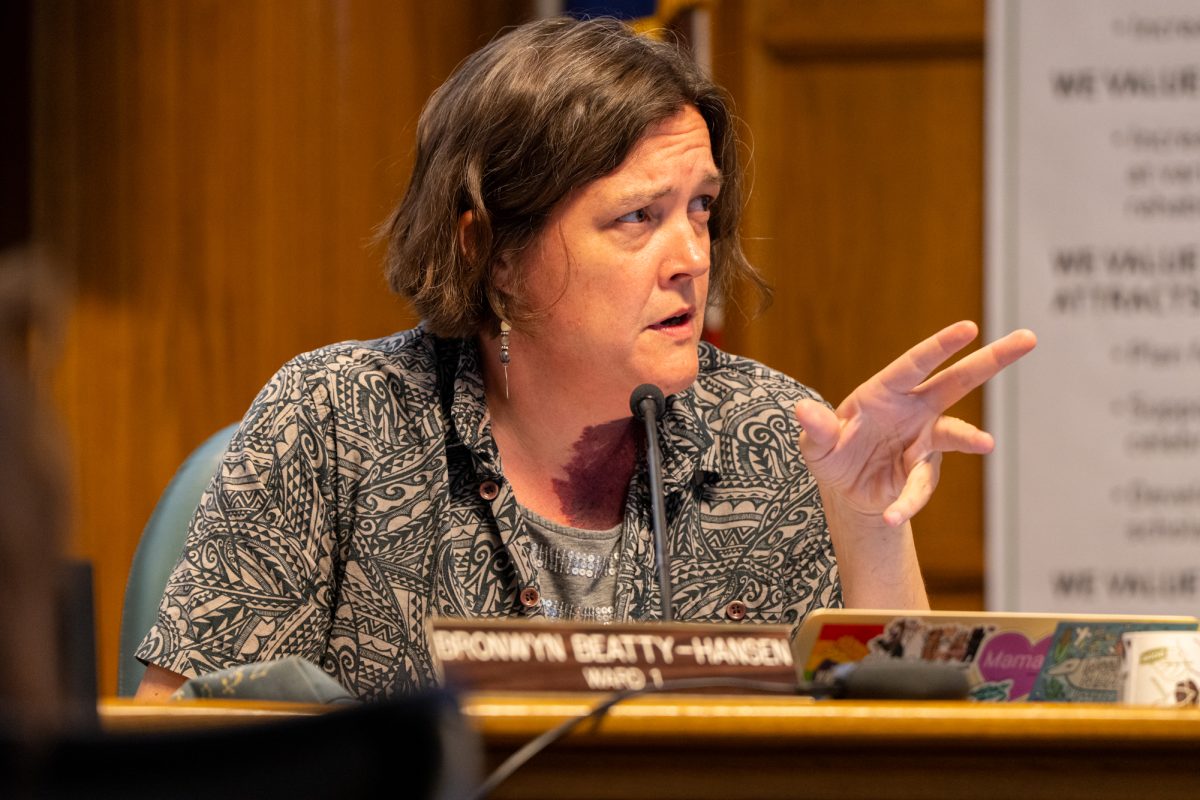

Gloria Betcher is the Ward 3 Representative on the Ames City Council, where she has served for 12 years.
Betcher is originally from Red Wing, Minnesota, home of Red Wing boots and pottery. She came to Ames with her husband to live in a house he inherited. Soon after, she was hired at ISU and has been teaching English for the past 33 years.
“People came to me originally and said that they wanted a neighborhood representative, somebody who could speak for the neighborhoods and they were worried because the other candidate for the board that was Ward 1 at the time was a chamber of commerce person who had never been involved in neighborhood activities, and they were concerned that their voice would not be heard, and they convinced me to run,” Betcher said.
Betcher has been very involved in the Ames Historic Preservation Commission for the past eight years. She and her husband also volunteer at the Ames History Museum, where he is on the board. Together they wrote a book, “Ames,” in 2014. It is part of the Images of America series and is full of pictures that document and explain Ames’ history.
Betcher’s favorite thing about Ames is “always the water. I always feel like I can go into a restaurant, order a glass of water, and it will always taste good, and I’ll be safe. I know that is not the case when I travel, and I am buying bottles of water all over the place because so many communities do not have good water.”
She is currently the Ward 3 Representative, which spans the western Highland area, south of Lincoln Way and Campustown, where she represents many students. In the past, she has also been the Ward 1 Representative.
Betcher mentioned how they “have had problems getting people to run. I actually was not going to run this last time, but nobody seems to want to run for council, so if no one will run for my seat, I’m more likely to run again.”
“My favorite story from that campaign [in 2014] is that the local radio station and the newspaper picked up on the fact that I had the lowest fundraising of any candidate, and I beat my opponent by over 800 votes. There is no connection between fundraising and winning as long as you have a good message, at least locally,” Betcher said.
To prepare for the city council meetings, she will read the packet they receive on the Friday before the usual public Tuesday meeting. Usually, the packets are around a hundred pages, but sometimes they can be over 400 pages. She likes to read through these and come up with questions.
On the Mondays before the public city council meetings, the council will meet with staff and the city manager to go through the packet and to make sure everyone understands everything. Here, members can ask questions and prepare staff to be ready with the facts when certain questions are asked in public meetings.
When asked what her favorite part of being a city council member is, Betcher said, “meeting people. I know so many more people than I did when I was just teaching at ISU, and it has really expanded my familiarity base; I’m familiar with people now at many different things I attend, and that’s been really good. Occasionally, I feel like I’ve had an impact and done something worthwhile.”
The hardest thing about being a council member is that “too many people think that if they tell me their opinion on something because they are my constituent, I must vote the way they want me to,” Betcher said. “I have more than one constituent, so all I am tell them is that I’m listening to you, I understand your position, but I am also listening to those hundreds of other constituents in my ward and thousands of Ames residents, so it is very hard to have to tell people it’s not all about you, but it is about the community, and I have to try and balance what I think is right.”
Betcher went on to describe the significance of students for the Ames community
“I’m always telling my students that if they live in Ames, they are residents of Ames,” Betcher said. “Students don’t see themselves as residents of the community, and I really want them to, because being a resident of Ames brings a lot of rewards, such as getting more involved in volunteering, and just getting to know your neighbor… good things can happen when there are connections. I would love to see students more involved. Students can do things; they can have a voice, they can have an impact, and things like data centers, environmental concerns, planning issues that impact them — we need them.”