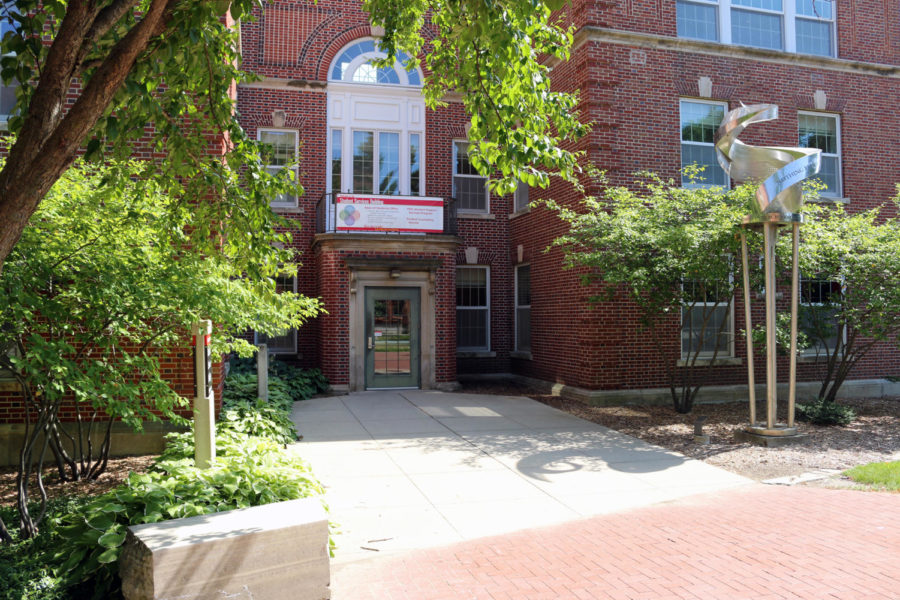

Last November, the Board of Regents met to discuss diversity, equity and inclusion (DEI) policies after a state-level decision. One such DEI policy change resulted in the dismantling of the Center for LGBTQIA+ Student Success.
It has since become an open study space for all students. It was rebranded as “The Center.”
Students held a “funeral” for the Center for LGBTQIA+ Student Success last April, drawing a large crowd together in front of the Memorial Union before marching to the free speech zone, in front of the Parks Library. The leaders of the service made it clear that their fight would continue, and they would continue creating a space for themselves on campus.
The loss of DEI policies at ISU stems from a decision made by the Board of Regents last school year, enacting the decision in May. Additionally, the Iowa State Senate passed a bill that removed the state civil rights code of protections based on gender identity.
Senate File 2435 restricts DEI initiatives in public institutions, prohibiting funding for DEI in the state and promoting such concepts at public institutions such as universities.
Alexis Newport is the vice president of the Pride Alliance, a student organization dedicated to providing a safe space for learning about and discussing the queer community. She provided context on how these changes impact queer students and organizations on campus.
“The retooling of the Center has shifted the responsibility of making sure queer students feel welcomed and accepted from the university into student organizations like Pride Alliance,” Newport said. “We feel like the loss of these support systems is tragic, and we continue to try and keep the vision of the Center alive through our community-building events.”
The Center currently provides a space for students to work on homework and study. Computers, screens, quiet spaces and lounge areas are all available to students to gather and work together. It also has space for student organizations to organize and host meetings and events.
This way, student organizations that relied on The Center can still use its space as needed. Although it doesn’t carry the same purpose it once had, the space is still there for groups like the Pride Alliance to utilize.
“Pride Alliance has always used The Center as a spot for meetings,” Newport said. “Its designation as a safe space for queer students was a big selling point in our use of the space. We still use The Center for some of our meetings, especially our game nights, since they’re a pretty ideal space for that. We find it important to still use the space for its original purpose to be important in keeping its spirit alive.”
The removal of The Center for LGBTQIA+ Student Success has not diminished its history, as even freshmen students are aware of it.
Josephine Ayala, a freshman in biology, shared her thoughts on The Center and what she knew of it.
“I know The Center was originally the building that the LGBTQIA+ clubs and allies met and have a space dedicated to them, much like the other buildings around campus dedicated to different groups,” Ayala said. “I have not seen it super publicized, but I do believe it’s a study center now.”
Ayala also spoke on DEI policies on campus as a whole, sharing what she worried about with decisions made last year. She spoke on the campus’s no-harassment policy, a school policy outlining protections against discrimination and harassment based on an individual’s protected status, or perceived protected status.
“I do think that removing specific restrictions and different things for safety could cause issues in the future.” Ayala said. “In the future, I’d like to see the DEI rules have more specific examples of what isn’t acceptable. The broadness of the no-harassment policy is great, but also leaves room for potential loopholes.”
Carter Billington, a freshman in kinesiology, shared what he thought of The Center and campus policies.
“I think [The Center is] not a bad idea as long as it’s something deemed necessary by the school,” Billington said. “I think it’s an important thing to have proper inclusion on campus for all students, regardless of their race or gender… I’d say that DEI policies should be improved and expanded on.”