
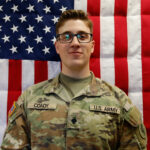
On March 1, Sgt. Declan J. Coady tragically lost his life due to an Iranian drone strike in Kuwait. He was a 20-year-old sophomore at Drake University. He was an Iowan, hailing from West Des Moines.
20 is the age at which the government believed he should be deployed in the Middle East, one of the most volatile geopolitical regions in the world. This is the age when many of us are going to classes as normal, working towards our dreams and goals. The age at which many of us find our first loves and possibly a life-long partner. The age many of us laugh and cry, find new hobbies and interests and brighten the lives of families and friends. This is the age at which the government deployed 20-year-old Declan J. Coady to the Middle East right before it attacked.
In reaction to the tragic news of the passing of at-the-time three U.S. soldiers, the president of the United States responded with the words, “And sadly, there will likely be more before it ends. That’s the way it is. Likely be more.” For a war Coady did not start, for a war Coady did not know was going to happen, he lost his life. Coady lost his life for the president to say that there will be more like him.
According to this report from Brown University, it costs the United States government and the American taxpayer around $35,000 per soldier in training. Further costs, such as wages and equipment, eventually add up to several thousand more. This money could have easily put Coady through college, gaining the same experiences as we hope to get, all with minimal loans. Yet, the cost of education in the United States has more than tripled since 1963.
The question here is not about loyalties. Sgt. Declan J. Coady is an American hero, deserving as much respect as any other soldier. He died protecting the liberties and rights as defined in the U.S. Constitution, which enabled me to be able to write this article. Coady is as much the hero as his sacrifice makes him.
The question here is as to why he was sent to a war in the first place. The legality of the war can be questioned endlessly. Whether the executive possessed the power to declare war, or whether the casus belli was justified, is a debate longing to be had. We must instead ask: on whose hands is this blood?
It is argued that the instigator of a conflict is the one responsible for the lives lost. This is a generally accepted notion, although not a precise rule, that lays the burden to be wise on the generals who declare. Essentially, the purpose is to demand patience and caution from world leaders and to prevent conflict. It is intended that the guilt lies on the conscience of those who send the soldiers to the war.
This guilt is not to be had by only one nation. It is undeniable that a soldier from Iran, or Israel, or anywhere on earth, also suffered the same fate. Some soldier who had the same chance at life as we all have, but was charged to suffer war. The blame lies on all the leaders, together and equally.
More people will die. Some of them may even be those who walk by us every day on campus. For those who send these soldiers to war, casualties are just another day at the office. For them, the guilt does not weigh heavily on their hearts. It weighs heavily on mine. I never knew Coady, but he could have been my friend. He could have been me.
Our talks about political discourse, left or right, matter nothing if we are all dead. When the dust settles, it will not be the politician’s body that is covered in a flag. It will be those whom we see, appreciate and love. I fear that when the dust settles, there will be no soldier left to bury the last one who dies, and those in their ivory towers who live will not concern themselves with the burden of our lives.
I hope the halls in the Memorial Union are carved with no more names. I hope students do not have to join the military to defend freedoms anymore. I hope those who are brandishing weapons instead spend their days wielding toys for their children. I hope these children do not become just another unfortunate incident of the war. None of this can happen unless we unequivocally oppose all war, for the sake of Declan J. Coady and for all those who have ever lost their lives to war.