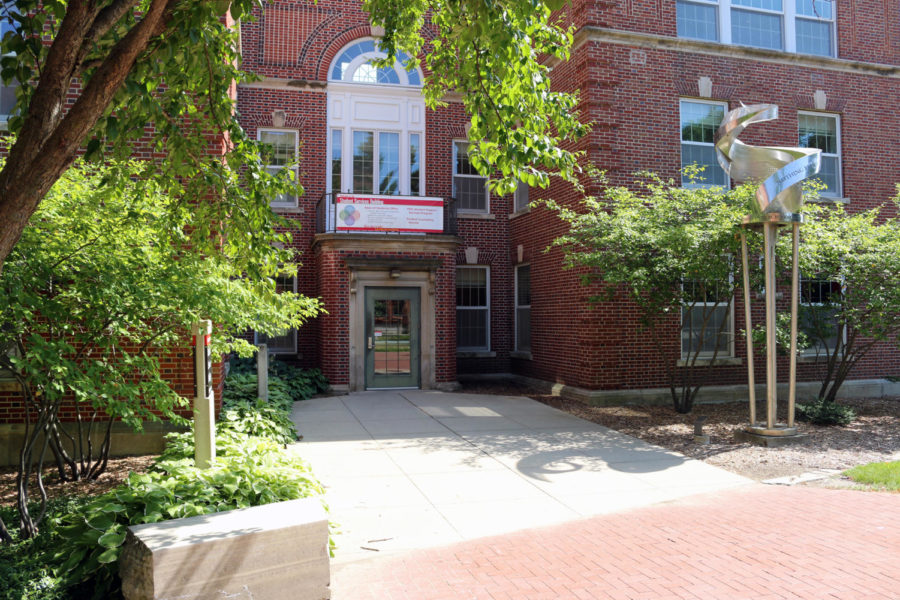

Iowa State University hosted their first Museum Meetup of the fall semester at the Farm House Museum on Central Campus last Thursday.
Farm House, one of ISU’s three on-campus museums, is a site of ISU’s early history and culture. Its history goes back about 165 years. Stepping into the Farm House is like stepping straight into the mid 19th and 20th century; the decor inside is sourced directly from the time period, or as close as possible.
The theme of the Museum Meetup was Women’s Domestic Artistries, celebrating the historical role of women and young girls in art throughout the Victorian and Civil War era. Domestic artistry consists of skills, crafts and activities that are based in the home.
Museum Meetups tend to have hands-on crafts or activities related to the featured collection. At this meetup, it was embroidery and drawing quilt patterns.
Threads of all different colors, embroidery hoops, needles and fabric were sprawled across the tables. Instructions with patterns and stitching techniques helped guide the attendees as they practiced weaving their own designs into sheets of white fabric.
The exhibition displayed antique examples of various knitted, crocheted, sewn and quilted works, as well as women’s magazines. These items would have been very prominent during the 19th and 20th century, the period the Farm House is set in.
“It was expected as part of being a young lady that you would have to learn how to sew, how to embroider,” Caitlin Patton, museum security and education program assistant, said. “Those were important skills for a young lady to have. As you can tell, it was a very gendered activity, though there are some examples of men also having these skills.”
The charm of Farm House has been preserved through many changes at Iowa State. Now, it serves as a time capsule into ISU’s earliest days.
The museum has been maintained to recreate an ideal version of what a typical farm home would have looked like from the mid 19th century up to the early 20th century, using photographs and design and furnishing trends as a framework. Most of the items inside are either directly from that period or meant to be as close as possible.
Attempting the crafts that are displayed in the curated collection is a way to connect to the art form. It can give a newfound appreciation for the featured pieces.
“I love getting a chance to work with students to try to enhance their museum experience,” Patton said. “So, that’s sort of the philosophy behind all of this, to try and give them a taste of the actual workmanship behind a lot of the things that are featured in here.”
For some students, the Museum Meetup was more than just a hands-on immersive experience. It was a way to connect with cultural traditions and personal passions.
“My family is Transylvanian Saxon, which is a German-speaking ethnic group that lives in modern day Romania. We have a very rich history of embroidery and doll-making and those are both hobbies of mine, so I felt I’d come here to learn a few new skills,” Samantha Bowser, a senior in advertising, said.
The exhibit was curated to give a deeper look into these familiar forms of artistry and craft that often go overlooked. Not only are these useful skills to have, but they can also be a way to add your own personal touch to belongings.
“I am not new to embroidery,” Finn Frischkorn, a junior majoring in art and design and religious studies, who interns for the University Museums collections department, said. “I really enjoy it, I find it as a very fun, creative way to express myself. Embroidery is really accessible to work on.”
The next Museum Meetup exhibition is from 6 p.m. to 8 p.m. Oct. 23 at the Christian Petersen Museum for a glass gallery exhibit, scavenger hunt activity, and glass etching craft. There will be free refreshments.
The calendar for future Museum Meetups can be found on the University Museums webpage.